Cape Town workshops that work with fabric under pressure
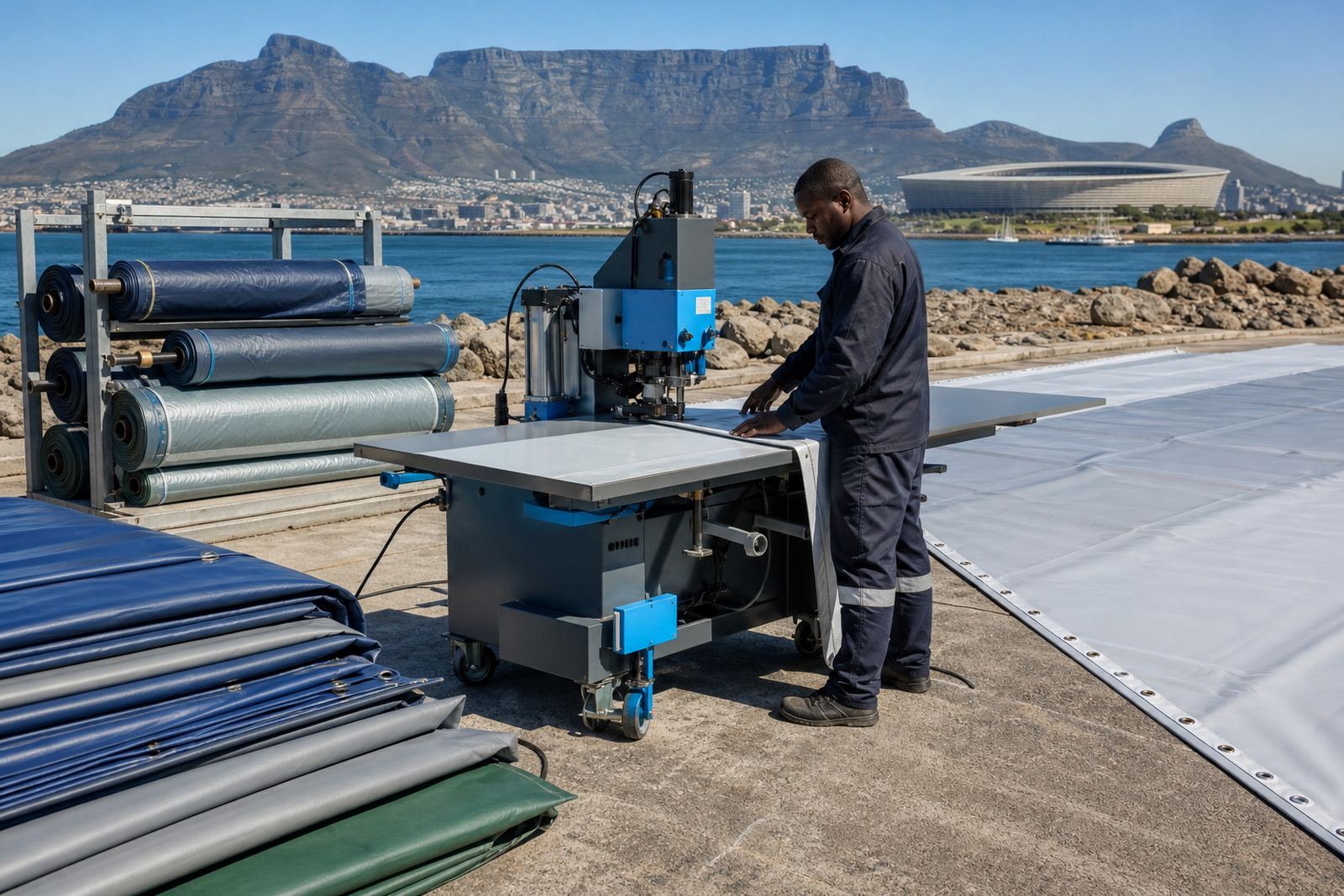
Cape Town signage, display and event shops often work with a mix of short runs and larger jobs, from banner panels and exhibition walls to tent skirts, covers and tarpaulin repairs. In that setting, weld quality has to hold up to wind, coastal moisture and frequent handling, especially where hems and joins take the strain. Our Cape Town support covers high-frequency radio frequency welding and hot-air or hot-wedge welding for PVC-coated fabrics, with attention to clean seam lines and repeatable results.
We assist teams that need a machine set up for the material in front of them, whether that is lighter banner stock, heavier tarpaulin grades or coated tent fabric. The practical details matter here: seam width, overlap, material thickness and the way the operator feeds the panels all affect the finished piece. Good keder work needs even heat and steady pressure, while panel joins need alignment that keeps the weld straight without distorting the fabric.
What Cape Town clients usually ask us to cover
Workshops in the city and in the broader Western Cape call on us for machine support where the output has to look neat and last through regular use. The usual jobs range from banner hems and reinforced edges to keder strips, eyelets and larger welded panels for marquees, shade structures and promotional goods. We also help with seam testing when a workshop needs to check whether the weld is holding across the full width, not just at the start and end.
- High-frequency welding for PVC-coated fabrics and coated sign material
- Hot-air and hot-wedge welding for hems, laps and panel joins
- Keder welding for rail-fed signage, tents and curtain-style assemblies
- Eyelet area reinforcement and edge preparation around fixing points
- Tooling alignment for straight seams and even pressure across the weld
Where a shop is switching between product types, the same machine can often be kept in better condition with careful setup, clean tooling and regular checks on the electrodes, rollers and guides. That helps when the workload changes from a run of exhibition banners to a batch of heavy covers in the same week.
Travel across the metro and what that means on site
We support Cape Town businesses through site callouts and scheduled visits, with travel planned around workshop access, traffic pressure and the distances between industrial areas. Some clients are close to the central commercial belt, while others work from the northern suburbs, the harbour side or the false bay side of the metro. Because welded fabric equipment is sensitive to setup, a site visit is often the quickest way to assess what is happening at the machine rather than guessing from the finished seam alone.
Travel and attendance are handled as part of the support plan, whether the need is a fresh installation, commissioning, a fault check or a machine handover after relocation. The aim is to get the unit running to the job in front of it, then make sure the operator can hold that setting during normal production. If there is a recurring issue with edge burn, weak bonding or uneven feed, the machine is checked from the tooling upwards.
- Machine installation and commissioning
- Tooling alignment and seam setup
- Fault finding on heating, pressure and feed issues
- Preventive servicing for steady workshop output
- Operator training on safe and consistent use
Coastal conditions and fabric handling in the Western Cape
Cape Town’s coastal air, changing temperatures and day to day movement between indoor and outdoor work can affect how PVC-coated fabrics behave. A banner or tarp that looks flat on the table may pull differently once it is welded, folded or fitted with keder. Salt air near the coast can also mean more attention is needed on moving parts, exposed fasteners and stored tooling, especially where a machine sits close to open doors or loading areas.
In these conditions, servicing is not only about keeping the heater or radio frequency unit working. It is also about checking the rollers, guides, seals, alignment surfaces and safety controls so the machine stays predictable from one batch to the next. A workshop that keeps eyelets, hems and welded edges consistent will usually spend less time on rework and less material on scrap.
For operators, safe use matters just as much as output. Guards, foot controls, emergency stops and heat handling routines should be checked regularly, and staff should know where the hot zones are on hot-air or hot-wedge equipment. Small habits matter here, like keeping offcuts clear of the working area and avoiding rushed handling when the fabric is still warm.
Parts and support we keep in play for Cape Town
For Cape Town support, we cover the practical items that keep welders working through normal production. That includes replacement parts, wear items, tooling checks and support for machines that need calibration or minor mechanical correction. When a workshop is pushing through seasonal work, such as event jobs or weather-related cover orders, a failed roller or worn electrode can slow the whole line. Having the right parts available cuts down on avoidable stoppages.
- Electrode refurbishment and roller replacement
- Parts supply for common wear components
- Seam testing after service or adjustment
- Preventive servicing plans for regular workshop checks
- Support for keder wheels, guides and edge tooling where fitted
We also assist where a workshop needs a cleaner finish on hems or repeated joins across wide panels. That may mean checking pressure distribution, heat timing and feed consistency, then setting the machine to suit the fabric thickness rather than forcing one setting across everything. It is practical work, and it shows in the finished seam.
How Cape Town teams reach us
Cape Town clients reach PVCWelder through the enquiry form on our contact page. That route works well for workshop managers, fabricators and production teams who need support on a machine, a seam issue or a planned service visit. It also helps us gather the details needed for the right follow-up, such as the machine type, the material in use and the fault or job requirement.
From Germiston, our team coordinates support for Cape Town and other centres across South Africa, including Johannesburg, Pretoria, Durban and Bloemfontein. The Cape Town area page covers local support for the kind of work that matters most in the city: keder, hems, larger panel joins and the machine care that keeps those jobs clean. Mandla Mnisi leads the business, with support from Alicia van der Merwe, Sibusiso Abrahams, Johan Mkhabela, Thandi Mokoka and Lebo Motsepe across sales, service, installation, training and parts.
For a workshop that depends on welded seams holding properly and looking right on the job, the details are what count. That is the standard we work to in Cape Town and across the Western Cape.