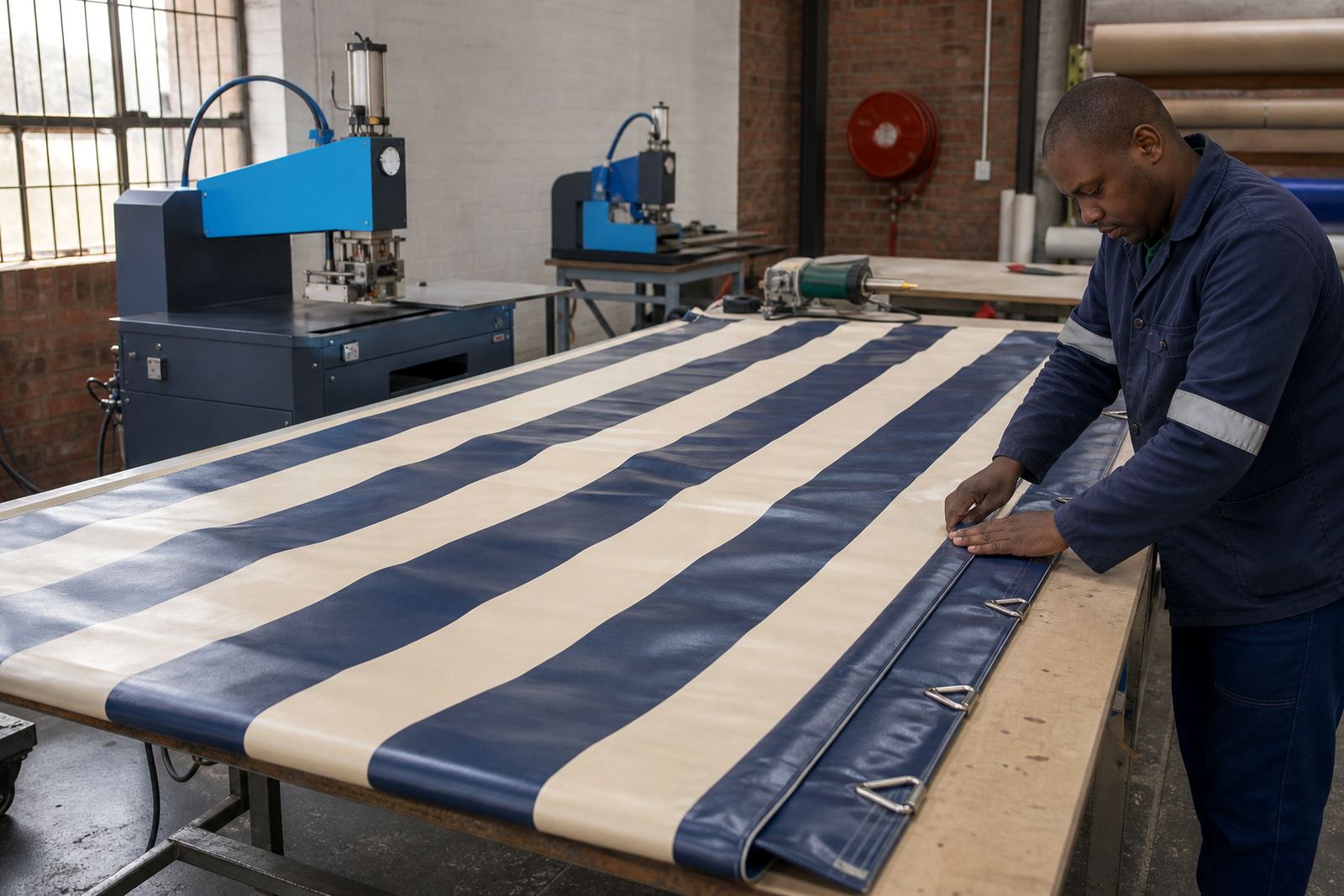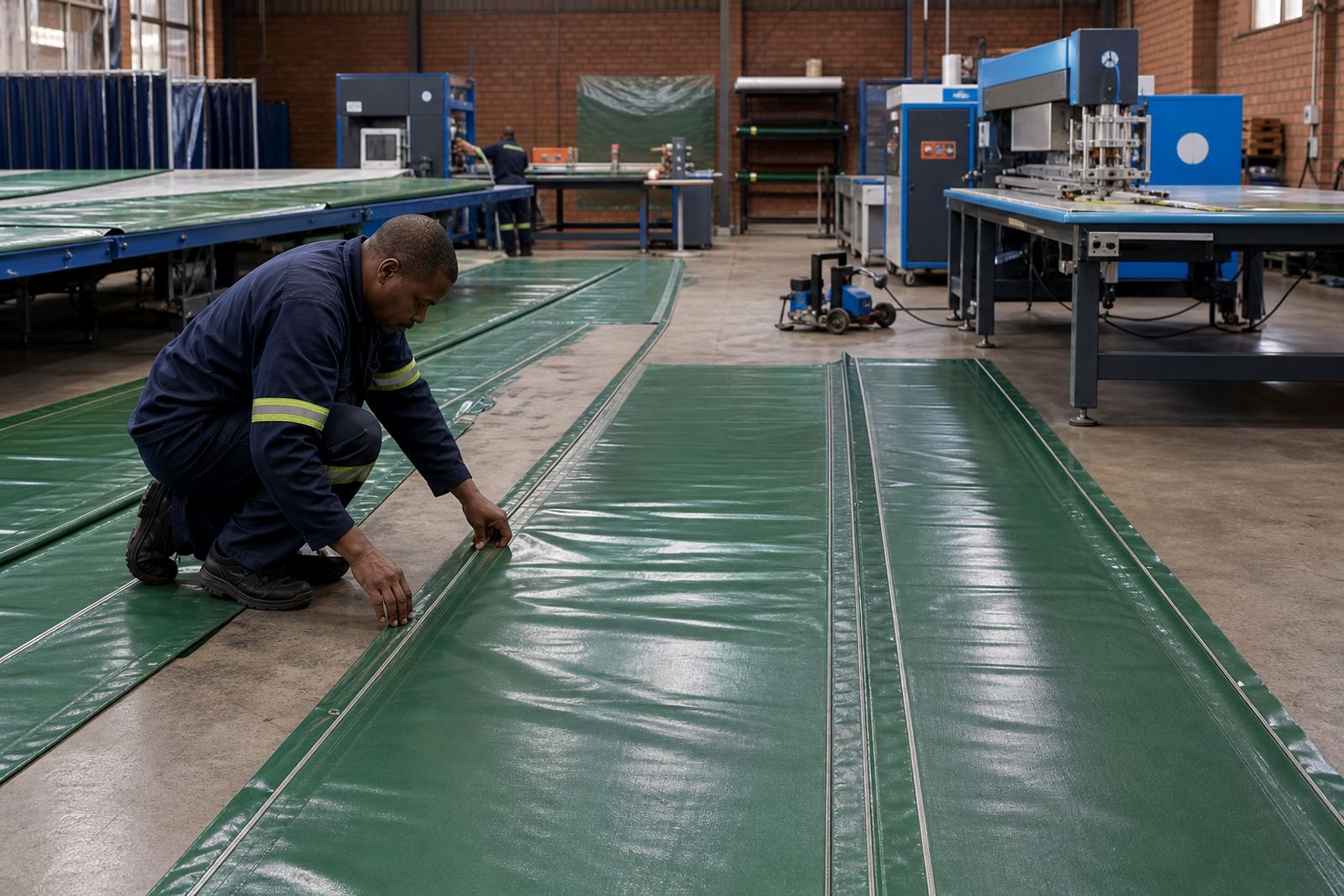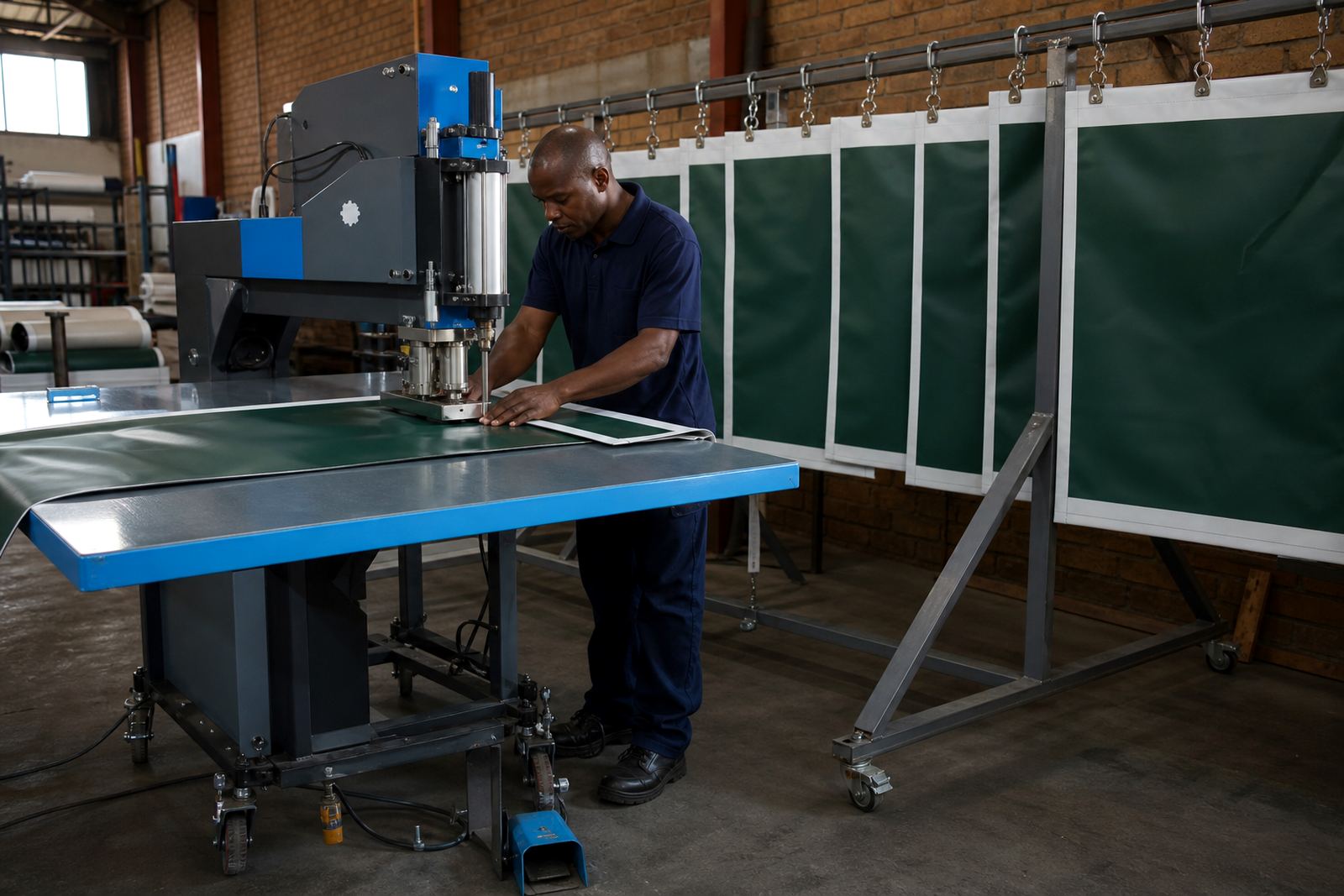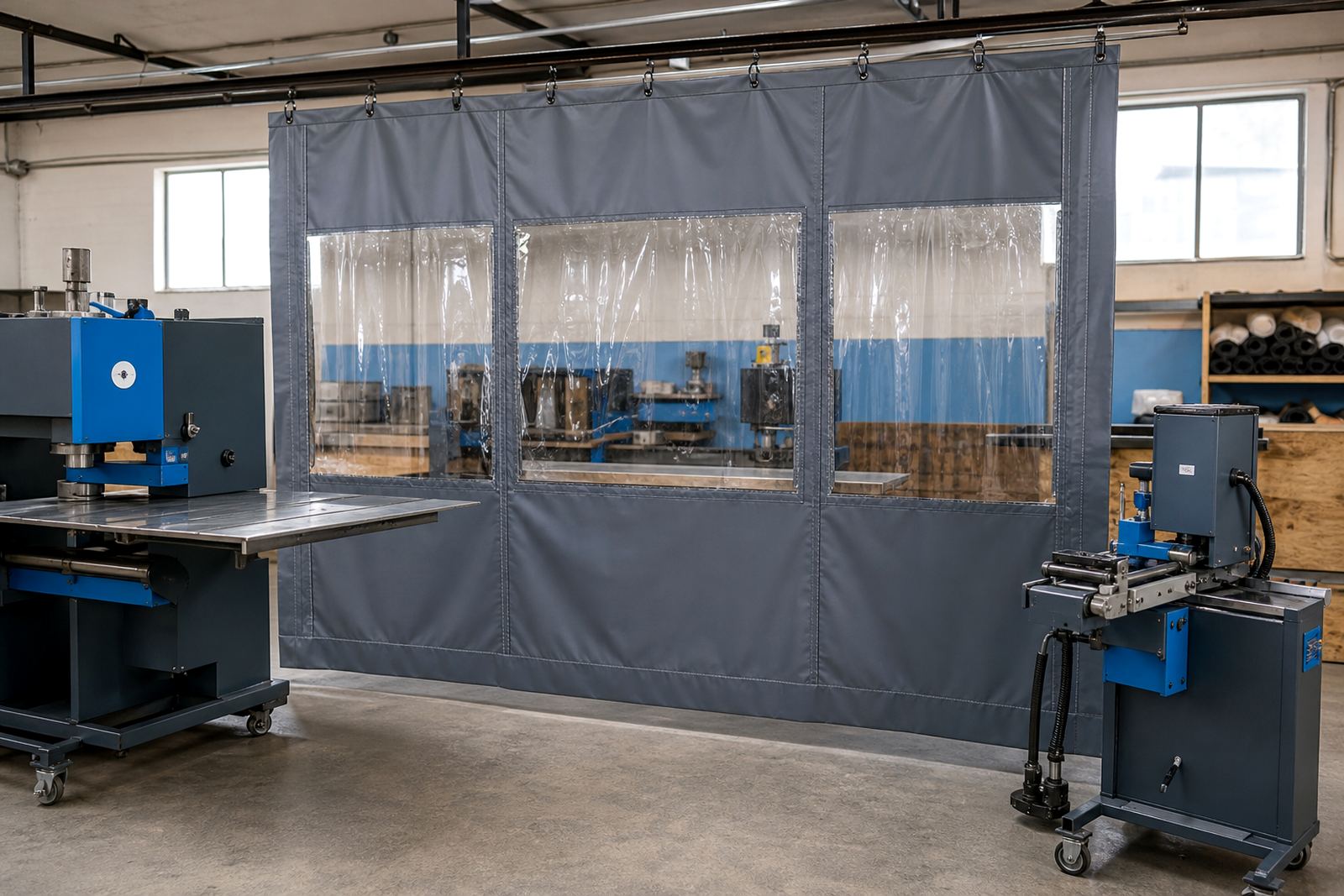
Factory panels set out for a Midrand line
The client was a factory supplier in Midrand working on industrial curtain panels for internal separation and covered openings. The brief covered PVC-coated fabric curtain panels, clear insert windows, hanging hems and tidy finishing for regular handling in a production area. The curtains had to move cleanly, hang straight and hold their shape after repeated use.
The site was in a working industrial area where fabrication happens around forklifts, dust and daily movement, so the material choice and seam layout had to suit that pace. We supplied and set up welding support for a repeatable panel run, with a method that kept each curtain section aligned from the first cut to the last weld.
- Panel type: PVC-coated fabric curtains with clear inserts
- Finish points: hanging hem, side hems and eyelet-ready edges
- Work area: Midrand, Gauteng industrial supply environment
- Priority: straight seams, even overlap and consistent panel size
The brief called for clean lines and practical handling
The main concern was consistency. The client wanted curtain panels that could be produced in batches without wandering seam lines or uneven clear sections. The clear inserts had to sit square in the panel layout, and the hems needed enough weight to help the curtains hang properly without curling at the bottom. It was also important that the finished pieces could take regular movement at access points and along partition runs.
We worked to a drawing set that allowed for welding allowances, hem folds and fixing points. For PVC-coated fabric, the useful choices were radio frequency welding for the main seam work and hot-air or hot-wedge welding where the panel shape or edge detail made that method more suitable. The project used both approaches where needed, with seam testing built into the process so the client could check consistency before full production carried on.
- Main seams welded for strength and neat appearance
- Clear inserts aligned to fixed cut marks
- Hems formed for stable hanging and reduced edge wear
- Sections prepared for eyelets and fixing hardware
How the weld set was handled on site
The equipment package was matched to the material thickness and the required seam type. For straight, repeated joints in PVC-coated fabric, high-frequency welding gives a controlled bond with even pressure across the seam area. Where the build called for longer runs or edge forming, hot-air and hot-wedge methods were used to keep the fabric moving in a controlled line. The result was a cleaner production rhythm and less rework on the trim side.
We also set up tooling alignment and roller adjustment for the job run. That mattered on the clear insert sections, because any drift at the guide edge shows quickly once light passes through the panel. A proper setup keeps the weld path true and helps the operator hold the same seam width from one piece to the next, even when the panel layout changes slightly.
- Weld methods used: high-frequency, hot-air and hot-wedge
- Detail work: seam overlap, hem folds and insert borders
- Alignment support: tooling set-up, roller checks and guide correction
- Finish work: eyelet zones prepared after seam completion
Timing from first set-up to handover
The job moved over three weeks. The first week covered site review, measurement checks and the welding plan for the curtain layout. The second week focused on machine set-up, operator handling and the first production pieces, with seam testing done as the panels came through. The third week was used for final finishing, adjustment on a few panel edges and handover of the completed curtain set.
Because the factory work had to continue around the project, the practical approach was to keep the panel sequence moving without crowding the work area. That reduced stoppages and gave the client time to check the curtain fit as sections were completed. The clear inserts stayed within tolerance, and the hems were formed to the same line across the batch.
- Week 1: survey, measurements and weld planning
- Week 2: set-up, operator training and first production run
- Week 3: finishing, fit checks and handover
- Production control: seam testing at intervals during the run
What changed after the curtains went in
The completed panels gave the client a tidy run of industrial curtains with clear visibility sections and straight hanging hems. The seams sat flat, the insert edges were properly contained and the finishing made the panels easier to handle during installation. For a factory setting, that matters because curtains that twist or wave around the edges create more work every time they are opened or moved.
The client also had a stronger base for later work. Once the weld settings, panel dimensions and hemming allowances were confirmed, the same format could be used for future curtain sets without starting from scratch. That is useful for production jobs in Midrand where site conditions can be busy and the fabric needs to move through the workshop in a clean, workable sequence.
- Outcome: straight, usable curtain panels with clear inserts
- Finish quality: even hem lines and tidy seam edges
- Fit result: easier handling during installation and daily use
- Future benefit: repeatable panel format for similar industrial orders
Machine care that keeps the weld line steady
For this kind of curtain work, machine care is part of the result. Regular servicing helps keep the welding pressure even, the guides true and the rollers in good condition. On PVC-coated fabrics, a small fault in alignment or heat control can show up as a weak seam, a burnt edge or a wavy finish, so preventive servicing is worth doing before production starts to drift.
Our support on the job covered fault finding, tooling alignment, roller replacement where needed and seam testing after set-up changes. Operator training also formed part of the handover because good handling reduces waste and keeps the weld path neat. In a humid coastal town or a dry inland workshop, the same basic discipline applies: clean tools, correct pressure and steady feed rate.
- Checks: guides, pressure, rollers and seam width
- Servicing: preventive maintenance and fault finding
- Operator support: training on handling, feeding and finish control
- Parts support: consumables and replacement components as required
Midrand curtain work with practical detail
This project suited the kind of work PVCWelder handles across South Africa: industrial curtain production, controlled welding and finishing that holds up in daily use. From Germiston, Ekurhuleni, we support machine installation, commissioning, training and service work for tarpaulin, banner and tent makers, with support areas in Johannesburg, Pretoria, Durban, Cape Town, Bloemfontein, Boksburg and Benoni.
For a Midrand client making industrial curtains, the key was not flashy presentation but repeatable output. The panels needed to match, the clear inserts needed to sit straight and the hems had to hang properly. That is what the welding process delivered, and it left the client with a practical curtain set that suited the factory floor.
Key facts
| Project | Industrial curtains with clear inserts and hanging hems |
|---|---|
| Town | Midrand, Gauteng |
| Material | PVC-coated fabric with clear viewing sections |
| Weld methods | High-frequency, hot-air and hot-wedge |
| Finish details | Side hems, bottom hems, eyelet-ready edges |
| Timeline | 3 weeks from review to handover |