Why the weld bay needs clear floor lines
In a tarpaulin or banner workshop, the welding area often carries more than one machine path at the same time. High-frequency welders, hot-air units, hot-wedge machines, cutting tables and rolling stock all bring cables, hoses and control leads into one space. If those lines cross walking paths or sit under loose offcuts, the risk of a trip rises fast and operators spend more time moving things out of the way than feeding material.
Clear floor lines also make the work easier to read. An operator can see where the main power feed runs, where the air line sits, and where the machine can turn without snagging on a hose. That matters in busy shops in Germiston, Johannesburg and Pretoria where production bays may be tight and teams shift from one job to the next through the same aisle. A tidy setup is not about neatness for its own sake, it supports safe movement and steadier daily output.
How cables and hoses should sit around PVC welding equipment
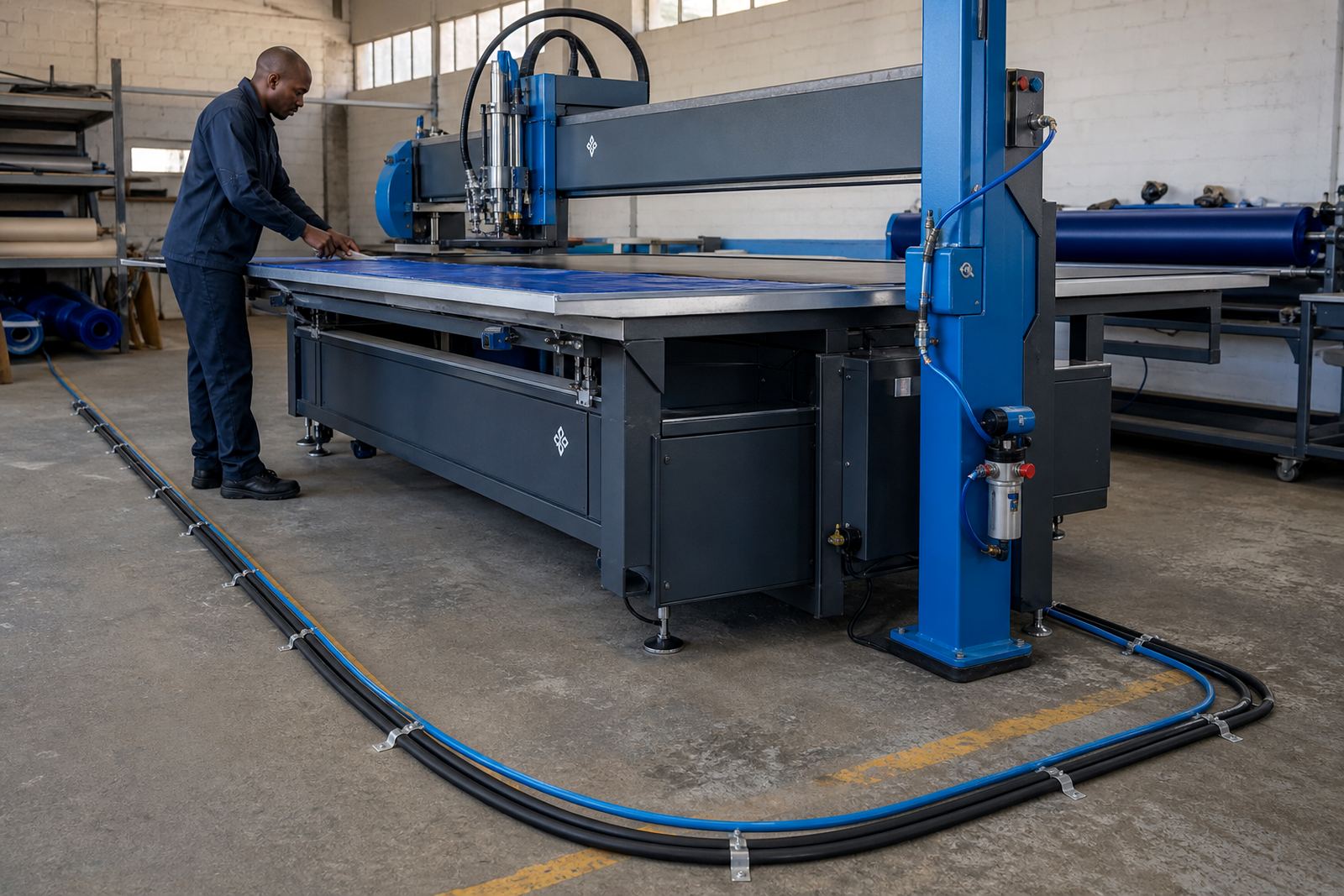
Each machine has its own needs. High-frequency welders usually need a clean route for the supply cable, earth connection and any control leads. Hot-air and hot-wedge machines add air lines, heat-related leads and guide cables that can be damaged if they are bent too sharply or dragged across rough concrete. The aim is to keep every line supported, visible and away from pinch points at the frame, roller area and loading side.
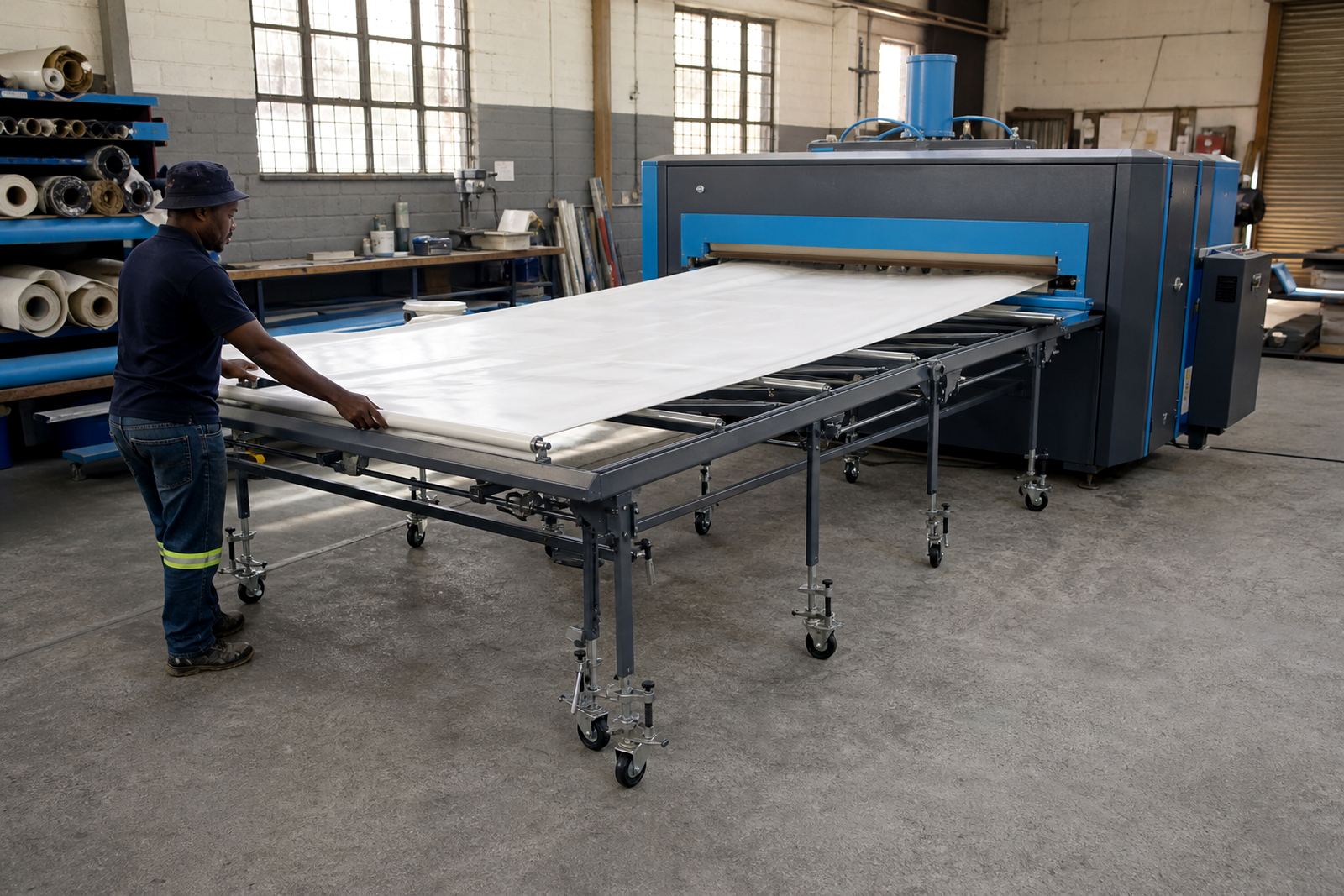
Practical housekeeping starts with how the machine is parked. Leave enough space for the operator to stand comfortably, feed PVC-coated fabric, and reach the control panel without stepping over anything. If the machine is moved often, mark the set-down point so the same route can be used each time. That helps avoid a fresh tangle every shift.
- Keep cables lifted where possible, using hooks, trays or wall runs.
- Keep hoses out of turning circles and away from sharp metal edges.
- Use the shortest safe route, not the quickest shortcut across the floor.
- Separate power lines from heat sources and moving rollers.
Trip risks in a fabric workshop are not small matters
A workshop floor that carries tarpaulin offcuts, eyelets, packed fabric rolls and extension leads can turn risky very quickly. One caught cable can pull a machine slightly out of position, disrupt a seam, or leave a hose kinked enough to affect the next weld. In heavier production, even a small slip can lead to a dropped roll or a rushed step that ends with bruised ankles or a damaged control box.
Coastal humidity in places like Durban and Cape Town can also make floors feel damp, especially early in the morning or after cleaning. Dust and grit stick to cables, then those cables get dragged through the same spots again. A proper housekeeping routine should include checking the floor before start-up, clearing loose scrap, and making sure nothing is trapped under the machine wheels or stand. That takes only a few minutes, but it changes the whole working rhythm.
- Walk the line from entrance to machine before switching on.
- Remove offcuts, packing straps and loose eyelets from walkways.
- Check for wet patches after cleaning or rain tracked in from loading bays.
- Make sure emergency access is not blocked by stored material.
Seam work runs better when the machine area stays orderly
Good cable housekeeping supports the quality of the weld itself. When operators are not stepping around loose leads, they can feed the fabric more steadily and keep tension even across hems, lap seams, keder strips and eyelet zones. That matters whether the job is a banner edge with a folded hem or a heavy tarpaulin panel that needs repeated passes to build a clean, durable seam.
If a machine is serviced properly, the cables and hoses tend to stay where they should. Loose strain at a connector, damaged insulation or a hose rubbing against a sharp bracket can create stop-start work that shows up later in the seam. In a busy site in Ekurhuleni, it is often the small things that cost the most time: a lead dragged under a trolley, a connector pulled sideways, a control cable wrapped too tightly after cleaning.
Useful habits during seam work include:
- Route leads away from the feed side so fabric can move freely.
- Keep scrap bins and tools on one side of the bay, not spread around the machine.
- Check that footswitches, guides and rollers are not sitting on tangled cords.
- After each changeover, return hoses and leads to the same position.
Servicing that keeps the wiring and hoses in shape
Cable housekeeping is not only about daily tidying. Preventive servicing should also include checking the condition of cables, plugs, earth points, hoses, connectors and mounting points. A machine that is used for banner work in Johannesburg may be switched on and off many times a day, while a tent maker handling larger panels may move the machine from bay to bay. Both patterns put wear on the same parts in different ways.
A service check should look for cracked insulation, loose fittings, heat marks, flattened hoses and strain at the points where the cable enters the machine. Tooling alignment, electrode condition and roller replacement are part of the same picture because a machine that runs straight and true puts less strain on the rest of the setup. If the operator notices a cable getting warm, a hose stiffening, or a lead pulling to one side, that needs attention before the next job starts.
On a practical level, servicing works best when the workshop keeps a simple record of what was checked, what was replaced and where the cable route has changed. That helps the next operator, especially if more than one shift uses the same equipment.
A Germiston example that shows the difference
In a Germiston workshop handling tarpaulins and PVC banners, the team had a common problem: leads were crossing the main walking path between the storage rack and the welding bay. Operators were stepping around them all day, and a trolley wheel had already snagged one hose near the machine base. The station worked, but it was untidy and slow.
After the layout was adjusted, the main power and control lines were lifted off the floor, the hose path was shortened, and the scrap bin was moved to the far side of the bay. The operator now had a clear route from the roll storage area to the machine, and the welding area itself was easier to keep clean. The change did not alter the welding method, but it improved the way the equipment could be used every day.
That is what good cable housekeeping does. It makes the bay easier to move through, reduces unnecessary wear, and helps the operator focus on the seam rather than the clutter around it.